
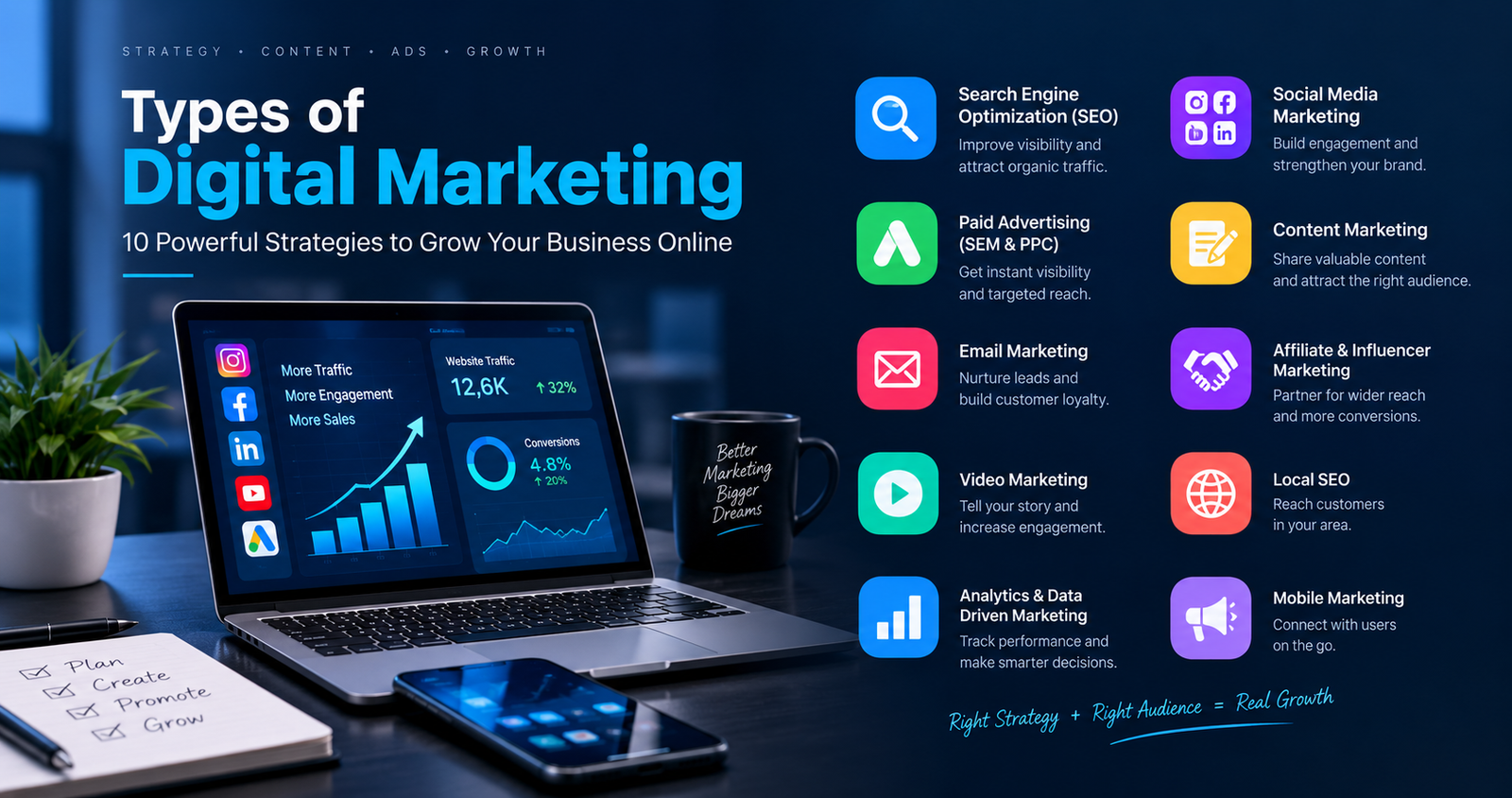
Types of Digital Marketing: 10 Powerful Strategies to Grow Your Business Online
Introduction
Digital marketing has become an important part of modern business growth. People use search engines, social media platforms, websites, and mobile applications to discover products, compare services, and make purchasing decisions. Businesses need an effective online presence to connect with these customers and remain competitive.
Understanding the types of digital marketing helps businesses identify suitable ways to promote their products and services. Each method has a different purpose. Search engine optimization attracts visitors through organic search results, while social media marketing helps businesses connect with audiences. Paid advertising can generate targeted traffic, and content marketing provides useful information that builds customer trust.
Digital marketing also allows businesses to measure campaign performance. Marketers can monitor website visits, engagement, enquiries, leads, and sales to understand whether their efforts are producing results.
Businesses exploring the types of digital marketing should understand how each channel supports different business objectives. Some methods focus on attracting website visitors, while others help generate leads, improve customer engagement, or increase sales. Selecting the right approach depends on the target audience, available budget, and long-term marketing goals.
However, choosing the right strategy requires more than following popular trends. Businesses should consider their objectives, target audience, budget, and available resources. This guide explores ten important strategies and explains how the types of digital marketing can help businesses improve their online presence.
What Is Digital Marketing?
Digital marketing refers to promoting products, services, and brands through internet-based platforms and digital communication channels. It includes website optimization, social media campaigns, search advertisements, email communication, video content, and other online promotional activities.
Unlike many traditional marketing methods, digital marketing provides opportunities to reach specific audiences and measure campaign performance. Businesses can study customer interactions and adjust their strategies according to collected data.
For example, a local clothing store may use Instagram to showcase new collections, SEO to attract people searching for clothing online, and paid advertisements to promote seasonal offers. Combining suitable channels can help the business reach more potential customers.
Learning about the different types of digital marketing also helps business owners understand how each channel contributes to customer awareness, consideration, and purchasing decisions.
The types of digital marketing available today give businesses several ways to communicate with potential customers. From organic search optimization to paid advertising, every method offers different opportunities. Understanding these options helps marketers create a balanced strategy instead of relying on a single promotional channel.
1. Search Engine Optimization (SEO)
Search engine optimization, commonly known as SEO, is the process of improving a website’s visibility in organic search engine results. It helps businesses attract visitors who are searching for relevant information, products, or services.
When people search online, they often visit websites that provide useful answers to their questions. A well-optimized website can improve its chances of appearing for relevant searches.
SEO is especially valuable for businesses that want to build a consistent online presence without paying for every website click. Among the major types of digital marketing, SEO is an important option for attracting visitors who are already interested in a particular topic or service.
Among the types of digital marketing, search engine optimization is particularly useful for businesses that want to attract visitors through relevant search queries. A well-structured website, helpful articles, relevant keywords, and a positive user experience can support long-term search visibility.
Main Types of SEO
On-page SEO focuses on optimizing website content and individual pages. It includes using relevant keywords, writing informative headings, improving title tags, creating useful meta descriptions, and adding internal links.
Off-page SEO involves activities that strengthen a website’s reputation beyond its own pages. Relevant backlinks, professional mentions, and genuine industry relationships can contribute to website authority.
Technical SEO helps search engines discover, crawl, and understand a website. Important considerations include mobile usability, page speed, indexing, website structure, and secure browsing.
Local SEO helps businesses improve visibility in location-based searches. Maintaining an accurate Google Business Profile, collecting genuine customer reviews, and publishing useful local content can support local discovery.
Benefits of SEO
SEO can increase organic traffic, strengthen brand credibility, and help businesses connect with people who already have an interest in their offerings.
Its results generally take time and require consistent improvement. Businesses should publish useful content, resolve technical problems, and monitor performance rather than expecting immediate results.
When comparing the types of digital marketing, businesses should consider SEO as a long-term strategy for improving search visibility and attracting relevant website visitors.
2. Social Media Marketing
Social media marketing involves promoting products, services, and brands through platforms such as Instagram, Facebook, LinkedIn, and YouTube.
These platforms allow businesses to share information, communicate with customers, demonstrate products, and develop recognizable brand identities.
Social media is useful for both new businesses trying to establish awareness and established companies seeking stronger relationships with their audiences. It is one of the widely used types of digital marketing because businesses can communicate with audiences through different content formats.
When comparing the types of digital marketing, businesses should consider how social media platforms help them build awareness and interact with customers. Consistent posting, useful information, engaging videos, and timely responses can help businesses establish a recognizable online identity.
Popular Social Media Content Formats
Businesses can publish short videos, reels, stories, carousels, photographs, educational posts, customer testimonials, and behind-the-scenes content.
For example, a restaurant can share food preparation videos, introduce its menu, and publish customer feedback. A digital marketing agency can post practical SEO tips, advertising insights, and examples of its work.
The most effective content depends on the audience and platform. Businesses should understand what their customers want to learn and which formats communicate that information clearly.
Creating an Effective Social Media Strategy
A successful strategy requires consistent publishing, meaningful interaction, and regular performance analysis.
Businesses should choose platforms based on their audience instead of attempting to maintain an active presence everywhere. They should also respond to relevant questions, review comments, and use analytics to understand which content receives attention.
Benefits of Social Media Marketing
Social media can improve brand awareness, encourage customer engagement, generate enquiries, and direct visitors to a website.
It also provides opportunities to understand customer interests and receive feedback. When businesses communicate consistently and provide valuable content, they can develop stronger relationships with their audiences.
Among the different types of digital marketing, social media marketing is particularly useful for businesses that want regular interaction with potential customers.
3. Paid Advertising on Search Engines (SEM and PPC Marketing)
Search engine marketing can involve paid advertisements that appear on search engine results pages. Pay-per-click advertising, commonly called PPC, is a model in which advertisers generally pay when users click their advertisements.
Google Ads is a widely used platform for reaching people searching for specific products and services. Businesses can use paid campaigns as part of their broader types of digital marketing strategy to generate targeted traffic.
Paid campaigns represent another option among the types of digital marketing. Businesses can use targeted advertisements to promote specific products, reach relevant audiences, and generate website traffic. Monitoring conversions and advertising costs helps marketers determine whether their campaigns are meeting business objectives.
How PPC Advertising Works
A business first identifies the products or services it wants to promote. It then researches relevant search terms, creates advertisements, selects suitable audiences, and establishes a budget.
When users search for related terms, eligible advertisements may appear depending on the campaign settings, competition, and advertising system.
For example, a website development company can advertise its services to people searching for website designers in a particular location. The advertisement can lead to a landing page containing service details and a contact form.
Important PPC Practices
Successful campaigns require relevant keywords, clear advertising messages, useful landing pages, budget monitoring, and conversion tracking.
Marketers should measure meaningful outcomes such as qualified enquiries, purchases, and the cost of acquiring customers. High click numbers alone do not guarantee business success.
Benefits of PPC Advertising
PPC can provide faster visibility than many organic marketing methods. It also allows businesses to target specific searches, test promotional messages, and measure campaign results.
However, paid advertising requires careful management. Campaigns that attract irrelevant visitors or use poorly designed landing pages can waste budget.
Businesses should regularly review performance and adjust their campaigns to improve results. When evaluating the types of digital marketing, they should compare advertising costs with the outcomes each campaign produces.
4. Content Marketing
Content marketing focuses on creating and distributing valuable information that attracts and retains a target audience. Instead of relying only on direct promotion, businesses provide content that answers questions, explains products, and helps customers make informed decisions.
Content marketing can support several other types of digital marketing by providing useful material for websites, search engines, email campaigns, and social media platforms.
Content marketing plays an important role in the types of digital marketing because valuable information can support several channels simultaneously. A single informative article may attract search traffic, provide material for social media posts, and offer useful information for email subscribers.
Common Content Marketing Formats
Blog articles, tutorials, guides, case studies, infographics, videos, downloadable resources, and educational social media posts are popular content formats.
For example, a digital marketer may publish articles explaining keyword research, website optimization, social media planning, and online advertising. These resources can attract readers who want to learn about digital marketing services.
A fitness equipment store might publish product care guides, while a travel company could create destination guides that help potential customers plan their journeys.
How to Build a Content Strategy
An effective content strategy begins with audience research. Businesses should identify common customer questions, understand their needs, and choose topics that provide genuine value.
Each article should have a clear purpose, accurate information, readable language, and a logical heading structure. Relevant keywords can help search engines understand the topic when they are included naturally.
Content should also be updated when information becomes outdated. Regularly reviewing published articles helps maintain accuracy and usefulness.
Benefits of Content Marketing
High-quality content can build trust, demonstrate expertise, support SEO, and help potential customers understand a business’s services.
Useful articles may continue attracting visitors long after publication. Content marketing can therefore contribute to long-term visibility when supported by consistent planning and quality standards.
5. Email Marketing
Email marketing involves communicating with subscribers and customers through email. Businesses use it to share updates, announce products, distribute useful resources, and maintain customer relationships.
Unlike public social media posts, email messages reach people who have chosen to receive communications from a business. Email marketing is one of the types of digital marketing that can support long-term customer relationships.
Different types of digital marketing can work together to improve customer communication. For example, a visitor may discover a business through SEO, explore its social media content, and subscribe to its newsletter. Relevant email updates can then help maintain the relationship over time.
Common Email Marketing Campaigns
Welcome emails introduce new subscribers to a brand. Newsletters provide useful updates, while promotional emails communicate relevant offers and product announcements.
Businesses can also send educational sequences that help potential customers understand their services before making a decision.
For example, an online learning platform might send course updates and learning resources to subscribers who have expressed interest in its programmes.
Best Practices for Email Marketing
Effective email campaigns use clear subject lines, relevant content, readable layouts, and suitable calls to action.
Messages should display properly on mobile devices and avoid overwhelming subscribers with excessive communication. Businesses must respect privacy requirements and provide a clear unsubscribe option.
Segmentation can improve relevance by allowing businesses to send appropriate information to different groups of subscribers.
Benefits of Email Marketing
Email marketing supports customer retention, repeat purchases, lead nurturing, and direct communication.
It can also help businesses maintain relationships with existing customers without depending entirely on paid advertisements or social media algorithms.
Regular performance analysis helps marketers understand which messages generate useful engagement and conversions.
6. Affiliate Marketing
Affiliate marketing is a performance-based promotional method in which individuals or publishers promote another company’s products or services in exchange for a commission on qualifying actions.
These actions may include purchases, completed registrations, or other outcomes defined by an affiliate programme. Businesses can combine affiliate marketing with other types of digital marketing to expand their reach.
Businesses evaluating the types of digital marketing should also consider performance-based approaches such as affiliate marketing. By collaborating with relevant publishers, companies can introduce their offerings to new audiences and track qualifying referrals according to programme conditions.
How Affiliate Marketing Works
A business establishes an affiliate programme and provides approved partners with unique tracking links. Affiliates share these links through suitable websites, blogs, reviews, or social media content.
When a user completes a qualifying action through an affiliate link, the tracking system records the referral according to the programme’s conditions.
For example, a technology blogger may publish a detailed laptop review with an affiliate link. If a reader purchases the product through that link and the sale qualifies, the blogger may earn a commission.
Choosing Suitable Affiliate Partners
Businesses should select partners whose audiences match their products and services. Relevant content and honest recommendations are more valuable than simply reaching a large number of people.
Affiliates should explain product limitations accurately and disclose commercial relationships where required.
Benefits of Affiliate Marketing
Businesses can expand their reach through external publishers and potentially pay commissions based on defined results.
Affiliates can earn income by recommending relevant products to their audiences. Both parties benefit when the relationship is transparent and the promoted products genuinely meet customer needs.
7. Influencer Marketing
Influencer marketing involves collaborating with content creators who have established audiences in specific interests or industries.
These creators may promote products through sponsored videos, product demonstrations, reviews, social media posts, and other forms of branded content.
Influencer marketing can be useful for businesses that want to introduce their products to communities that already trust a creator’s recommendations. It can complement other types of digital marketing by bringing products to relevant audiences.
The types of digital marketing used by a business may include influencer partnerships when its audience follows relevant content creators. Suitable collaborations can help demonstrate products, communicate brand messages, and introduce services to people who may be interested in them.
Selecting the Right Influencer
Follower numbers should not be the only consideration. Businesses need to assess audience relevance, engagement quality, content style, credibility, and campaign objectives.
A smaller creator with a highly relevant audience may provide better results than a larger creator whose followers have little interest in the product.
For example, a clothing brand may collaborate with a fashion creator to showcase a new collection. A local restaurant might work with a food creator who regularly shares recommendations about nearby dining options.
Planning an Influencer Campaign
Businesses should establish clear goals before beginning a collaboration. These goals might include increasing awareness, generating website visits, encouraging enquiries, or promoting a new product.
The campaign brief should communicate expectations, deliverables, timelines, and disclosure requirements. After publication, marketers can review engagement, referral traffic, enquiries, and sales.
Benefits of Influencer Marketing
Influencer campaigns can introduce brands to new audiences and provide relatable product demonstrations.
Their effectiveness depends on authenticity, audience alignment, and clear measurement. Transparent partnerships help maintain trust between creators, businesses, and their audiences.
8. Video Marketing and Reels Marketing
Video marketing uses visual content to educate, entertain, demonstrate, or promote products and services.
Businesses publish videos on platforms such as YouTube, Instagram, Facebook, and LinkedIn. Short-form formats, including Instagram Reels and YouTube Shorts, allow brands to communicate information in a concise and engaging way.
Video marketing is among the types of digital marketing that help businesses demonstrate products and communicate information visually.
Video marketing adds a visual element to the types of digital marketing available to businesses. Tutorials, product demonstrations, and educational reels can explain information quickly and encourage viewers to explore related services or website resources.
Popular Video Marketing Formats
Businesses can create tutorials, product demonstrations, customer testimonials, behind-the-scenes videos, brand introductions, interviews, and educational clips.
For example, a car detailing studio can publish videos showing cleaning processes, explaining protective treatments, and presenting completed projects.
A digital marketing professional might create short videos about website optimization, advertising mistakes, or practical ways to improve social media content.
Creating Effective Marketing Videos
Every video should have a clear objective and a message that viewers can understand quickly.
An engaging opening, appropriate visuals, readable on-screen text, clear audio, and a relevant call to action can improve the viewing experience.
Businesses should also consider platform requirements, video dimensions, accessibility, and mobile viewing. Subtitles can help viewers understand content when sound is unavailable.
Measuring Video Performance
Useful metrics include views, watch time, audience retention, shares, comments, website visits, and conversions.
The most important metrics depend on the campaign objective. A brand awareness video may focus on reach and retention, while a product demonstration may aim to generate enquiries or sales.
Benefits of Video Marketing
Video can demonstrate products more clearly than text alone and communicate a brand’s personality.
It can also support social media campaigns, website content, and advertising. Combining video with other types of digital marketing helps businesses distribute useful messages to different audience groups.
9. Mobile Marketing
Mobile marketing focuses on reaching customers through smartphones and tablets. It includes mobile-friendly websites, SMS campaigns, mobile advertisements, application notifications, and location-based promotions.
Because many people use smartphones to search for products and services, businesses need to ensure their online experiences work properly on smaller screens.
Mobile-friendly experiences should be considered when planning the types of digital marketing for modern audiences. Fast-loading pages, readable content, simple enquiry forms, and convenient contact options can help smartphone users interact with a business more easily.
Important Mobile Marketing Methods
Mobile-friendly websites help visitors access information without unnecessary zooming or scrolling. SMS marketing can communicate time-sensitive updates to people who have agreed to receive messages.
Mobile advertisements allow businesses to reach suitable audiences through supported applications and websites. Push notifications can provide relevant updates when users have chosen to receive them.
Location-based promotions may help businesses communicate offers to customers in relevant areas, subject to applicable permissions and privacy requirements.
Improving the Mobile Experience
Websites should load quickly, use readable text, display clear navigation, and provide buttons that are easy to tap.
Contact information, enquiry forms, booking options, and payment processes should be straightforward to use.
For example, a local service provider can create a mobile-friendly website with service details, location information, a simple enquiry form, and a WhatsApp contact option.
Benefits of Mobile Marketing
Mobile marketing helps businesses reach people through devices they frequently use.
A convenient mobile experience can reduce barriers between discovering a business and contacting it. However, businesses should respect user preferences and avoid sending excessive or unwanted messages.
10. Digital Public Relations (Digital PR)
Digital public relations focuses on strengthening a brand’s online reputation and visibility through media coverage, expert contributions, online publications, and relevant website mentions.
Traditional public relations often focuses on relationships with media organisations and the public. Digital PR applies similar principles to online environments and can support a broader types of digital marketing plan.
Digital PR complements other types of digital marketing by helping businesses build online credibility through relevant publications, expert contributions, and useful industry information. A consistent reputation can support customer confidence and strengthen a brand’s overall online presence.
Common Digital PR Activities
Businesses can contribute expert commentary, publish original research, share useful industry information, participate in online events, and offer relevant stories to publications.
For example, a business introducing a new service may share a meaningful announcement with industry websites. An experienced professional might contribute insights that help readers understand a developing topic.
Successful digital PR requires useful information and credible communication rather than promotional claims without evidence.
Building Relationships With Online Publications
Businesses should identify publications that serve relevant audiences and provide information that matches their editorial interests.
Original data, expert knowledge, practical resources, and well-supported insights may offer more value than generic promotional messages.
Any outreach should be accurate, respectful, and relevant to the publication.
Benefits of Digital PR
Digital PR can increase brand awareness, improve credibility, and create opportunities for relevant media coverage and backlinks.
It can also help businesses establish their expertise within an industry. Results depend on the quality of the story, the relevance of the publication, and the value provided to its audience.
How to Select the Best Digital Marketing Strategy for Your Business
Choosing suitable online marketing methods requires a clear understanding of business goals, audience needs, budget, and available resources.
Not every business needs to use every channel. A focused strategy often makes it easier to manage campaigns, measure outcomes, and improve performance. Understanding the types of digital marketing helps business owners make informed choices.
Choosing between the types of digital marketing requires businesses to compare their objectives, audience behaviour, resources, and expected outcomes. A local business may prioritize local SEO and social media, whereas an online store may focus on product pages, email campaigns, and paid advertising.
1. Understand Your Target Audience
Businesses should identify their customers’ interests, challenges, locations, and online habits.
Understanding these factors helps marketers select suitable platforms and create messages that address genuine needs.
For example, a local restaurant may benefit from location-based searches and visual social media content, while a business-to-business company may focus on professional networks and detailed educational resources.
2. Set Clear Marketing Goals
Before choosing channels, businesses should decide what they want to achieve.
Goals may include increasing website traffic, generating qualified leads, improving online sales, building brand awareness, or retaining existing customers.
Specific goals make it easier to select suitable activities and evaluate results.
3. Establish a Realistic Budget
Businesses should determine how much they can invest in content creation, advertising, website improvements, tools, and campaign management.
SEO and content marketing often require consistent effort over time. Paid advertising may provide quicker exposure but needs ongoing budget management.
A practical plan should consider both financial costs and the time required to maintain each activity.
4. Choose Relevant Marketing Channels
The most appropriate channels depend on the business model and audience.
A local service provider might prioritize local SEO, customer reviews, useful website content, and targeted social media campaigns. An online store may benefit from product pages, paid search, email marketing, and video demonstrations.
A business serving professional clients may focus on educational articles, case studies, LinkedIn content, and lead-generation campaigns.
5. Measure Results and Improve Performance
Businesses should monitor metrics that relate directly to their goals.
Website traffic, qualified enquiries, conversion rates, customer acquisition costs, email engagement, and advertising returns can help explain campaign performance.
Marketers should test different approaches carefully and use the findings to improve future activities. Reviewing results regularly helps businesses avoid spending resources on methods that do not support their objectives.
Common Digital Marketing Mistakes to Avoid
Even well-planned campaigns can perform poorly when businesses overlook important details.
One common mistake is trying to use every available platform without understanding the target audience. This can spread resources too thinly and make consistent publishing difficult.
Another mistake is focusing only on views, followers, or clicks instead of meaningful business outcomes. Engagement can be useful, but it should be considered alongside enquiries, conversions, and customer relationships.
Businesses should also avoid publishing low-quality content simply to maintain a schedule. Useful, accurate information is more valuable than repeated posts that offer little benefit.
For SEO, excessive keyword repetition can make articles difficult to read and may be treated as keyword stuffing. The focus keyword types of digital marketing should appear naturally, supported by related terms and informative content.
One important lesson when using the types of digital marketing is that more activity does not always produce better results. Businesses should prioritize relevant content, accurate targeting, appropriate tracking, and a good customer experience instead of publishing repetitive material simply to increase keyword usage.
Ignoring mobile usability, failing to track campaign performance, and neglecting customer feedback can also limit results. Regular reviews help identify these problems and create opportunities for improvement.
The Importance of Combining Different Digital Marketing Channels
Individual marketing channels can support different stages of the customer journey. Combining suitable channels may help businesses create a more consistent experience.
For example, SEO can attract visitors who are searching for information. Helpful blog content can answer their questions, while social media can introduce related resources to a wider audience.
Paid advertisements can support specific campaigns, and email marketing can maintain communication with interested subscribers. Video content can demonstrate products, while digital PR can improve a brand’s visibility through relevant publications.
The goal is not to use every available channel. Instead, businesses should choose methods that complement one another and support measurable objectives.
Consistent branding, accurate information, and clear communication can help customers recognize a business across different platforms. A clear understanding of the types of digital marketing makes it easier to coordinate these activities.
Future Trends in Digital Marketing
Digital marketing continues to develop as technology, customer expectations, and online platforms change.
Artificial intelligence tools can help marketers organize research, generate initial content ideas, analyze campaign data, and automate selected tasks. Human review remains important for accuracy, originality, relevance, and brand consistency.
Personalization is another important area. Businesses can use appropriate customer information to make communications more relevant while respecting privacy and consent requirements.
Short-form video, useful educational content, mobile-friendly experiences, and data-informed campaign planning continue to offer opportunities for businesses.
Search experiences are also changing, making clear, trustworthy, and genuinely helpful website content increasingly important. Businesses should focus on answering customer questions rather than creating pages solely to repeat keywords.
Instead of following every new trend, marketers should evaluate whether a particular technology or platform helps their audience and supports their business goals. Understanding current types of digital marketing can help businesses choose relevant methods as online behaviour evolves.
Conclusion
Understanding the types of digital marketing helps businesses identify effective ways to reach audiences, build trust, and improve their online presence.
SEO supports organic search visibility, while social media marketing encourages interaction. PPC advertising can provide targeted exposure, and content marketing helps audiences find useful information. Email marketing supports ongoing communication, while affiliate and influencer marketing create opportunities to reach new audiences.
Video marketing makes product demonstrations more engaging, mobile marketing improves smartphone experiences, and digital PR supports brand reputation through relevant online coverage.
The most effective types of digital marketing are those that match a business’s needs and provide value to its audience. Businesses can begin with a few suitable channels, measure their performance, and expand their strategy when they have enough information to make informed decisions.
Each method serves a different purpose. The right combination depends on business goals, customer needs, budget, and available resources.
Businesses should begin with a clear strategy, create useful content, measure meaningful results, and improve their campaigns consistently. By focusing on customer value and choosing suitable channels, they can build a stronger online presence and work towards sustainable business growth.